The American Involution
or, why no one is getting an internship

Roughly 135 rebels, dressed like Indians, throw 340 chests of tea into a harbor. Across town, a tax man is strung up, covered in tar, and feathered by the locals. Firing into a Boston crowd, British soldiers kill 5 colonists. This is the American Revolution.
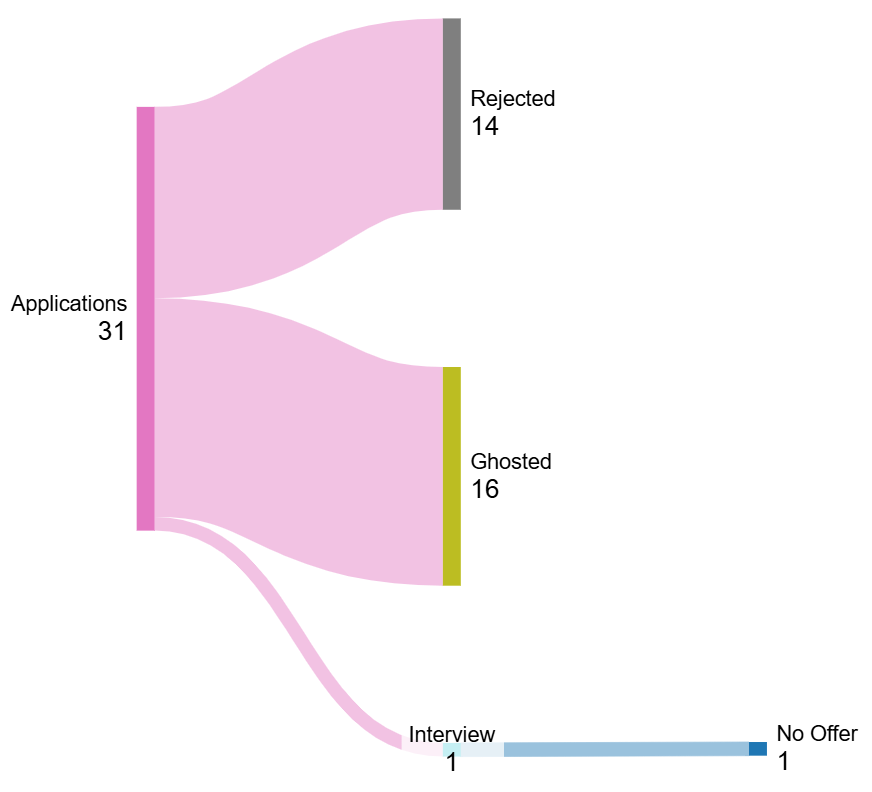
An electrical engineering student applies to 46 internships, and gets two responses - both rejections. His CS friend discusses his vibe coded auto-applier. He’s making Sankey diagrams and posting them to r/dataisbeautiful.
One interview → zero offers. This is the American Involution.
What is Involution?
Involution was first coined by anthropologist Clifford Geertz, in his work “Agricultural Involution: The Processes of Ecological Change in Indonesia.”
From 1830-1870, the colonial Dutch cultuurstelsel1 (Cultivation System) placed a strict production requirement: 1/5 of a Javanese villager’s land or labor shall be dedicated to growing cash crops. These crops would then be sold abroad by the Dutch, aiming to reverse the Netherland’s economic woes post Belgian Revolution.
During this same period, Java was experiencing immense population growth: 1830’s 7 million quadrupled to ~28 million by 1900. As an agrarian society, the vast majority of this new population was enlisted to work in rice paddies. Yet, due to the cultuurstelsel, there wasn’t enough land for more paddies accommodating this increase. Typically, you’d expect this to lead to mass starvation, emigration, or systematic collapse. However, rice is nutritious enough to support the population, the neighboring islands are far poorer, and the Dutch are in control. Instead, the complexity within the paddies skyrocketed. Irrigation became overly convoluted, and weeding was intricate work. There were too many Indonesian cooks in the kitchen2.
So, despite systematic increases in paddy infrastructure, there was no proportional increase in marginal returns. Thus, Geertz coins the portmanteau of involution (inward evolution). An involuted system is one that is not expanding naturally: instead, opting to swallow itself.
To give an example of modern involution, I will now ask you to be Chinese.
An exercise in being Chinese
You are going to be born in Lushan County of the Henan province. The most notable thing about your birthplace is a large statue of the Buddha. And, despite Henan being China’s third largest province, it houses zero 985s - the system of universities equivalent to the US’s Ivy League. Your parents were never able to escape this place. You’re going to change that, you think to yourself in the womb.

You make up your mind. You’re going to go to Beijing’s crown jewel, the Harvard of the East: Tsinghua University.
You are then born. I will assume that you have 18 years of excruciating preparatory courses in the tank, and you can effectively prepare for the most important day of your life. Good luck!
The Gaokao, or the National College Entrance Examination, is taken by about 10 million students every year. This exam lasts 9 hours (spread across 2-3 days), testing student’s affinities for the Chinese language, mathematics, physics, chemistry, biology, political science, history, and foreign language. This almost singlehandedly determines where you go to college, or if you can go at all.
Despite the national moniker, Gaokao administration is coordinated on a provincial level. And, analogous to having higher in-state admission rates at flagship universities in the US, universities in one province view in-province applicants more favorably. This includes the elite 985 universities. Score cutoffs for admission to these universities are set province by province, with ~1/3 of these universities in Beijing or Shanghai. Score cutoffs outside of the province the university lies in are quite high, particularly if there is a large population of test takers in that province.
Of the 12.75 million Gaokao testees in 2023, 1.5 million were from Henan. When 985 score cutoffs are released (after the exam is taken), Henan always requires the highest scores for university admission. One Reddit comment claims that Henan faces disproportionate “Gaokao discrimination,” with its finest warriors scoring incredibly just for mediocre placements. Inter-province moving for Gaokao related reasons is also common.

Within Henan, involution thus rears its head. Here, however, instead of complex rice paddies, our result is a boiling pot for young students. There are only so many slots for top universities. Parents will do anything to get their kids into Tsinghua or Peking. They will hire professional tutors. Anyone hoping to compete will also then hire a tutor - otherwise you are in an insurmountable deficit due to limited placement slots. Those who hope to further differentiate themselves will then read more preparatory materials. Everyone else must read more. Such differentiation continues until only the strongest remain.
The Modern Definition
Since 2020, involution has been added to young Chinese netizen’s vocabulary under the name 内卷 (nèijuǎn). They use nèijuǎn to describe the increasingly stagnant function of expected life outcomes vs. effort in China.
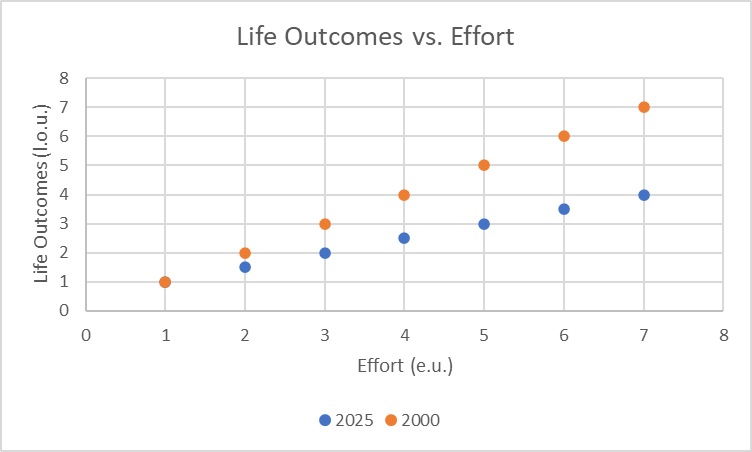
Those who participate in the system are said to be “zài nèijuan” (in the process of involuting). These are those who rise to the increasing standards of college admissions and embrace the workhorse culture. People using this term do not intend it as a complement.
Then, there is the class said to be Tang Píng (lying flat). Originally popularized by the netizen “Lying Flat Is Justice,” advocates refuse to be likened to an ox pushing a cart forward. They instead lie there.3
The exigence of this movement doesn’t just lie in the Gaokao - this baseline effort increase permeated throughout a number of sectors, most notably tech.
Within Chinese tech, a so called “996”4 system has become normalized in the most prestigious firms. This stands for “9 AM to 9 PM, 6 days a week.”
Lets say your Chinese self really did make it to Tsinghua. Amongst the elite, they now face the competition of their peers for top firm placements. Against all odds, this wunderkind self makes it to a cushy Huawei job. They are now faced with 996. One of the greatest sparks behind the original Tang Píng movement was the 2020 death of a 23-year-old employee at Pinduoduo, an online Chinese retailer. After getting out of work (around midnight), he suddenly keeled over and died, likely from overwhelming stress and exhaustion.
For dramatic effect, and to enhance my point, this is what happened to your Chinese self. Sorry!
Going Paul Revere Mode
We now come back to the title of this article. Looking around, you might not feel involution in the same way of the Indonesians or the Chinese. However, there are two windows through which a similar process can be seen amongst American youth: that of the internship, and that of the founder.
To dox myself, I go to a top computer science school. I am thus naturally exposed to the sweatiest, smelliest tryhards around. Yet these tryhards, despite their leetcode grinds, their “passion” projects… they aren’t getting their FAANG5 internships. Those who do receive one are launched into the annals of the programs history, to be worshipped forevermore. The equilibrium has shifted.
Over the course of a single day walking around campus during internship season, I overheard three separate conversations about vibecoding internship application bots. Hundreds of applications are sent out over LinkedIn, Indeed, anywhere. They are lucky to hear back from one or two to offer an interview. In 2025, Handshake, an internship posting platform, reported that tech internships received 273 applications per position, corresponding to a 0.37% acceptance rate. The general average, 109 applications, nearly doubled year over year compared to 2024.
The compounding effects of having an internship on your resume are quite large, especially if it corresponds to a recognizable company. This isn’t just an internship. It’s your life. Each year, the fates have their scissors prepared to cut your string, ready to snuff you out. Alas, you get an internship, and they are foiled — till next year!
People respond via increased resume farming, an attempt of signaling their newlywed status with the grind. Others then follow suit, and the standards for getting an internship rise.
A similar method of signaling is found amongst the silicon valley founder. Everyone is competing for VC money. New trends constantly appear and disappear, an iterated prisoners dilemma where no one is rational and no strategy is stable. Currently, agency is the buzzword of choice.
Those with agency are the ones who get things done. More agency, more work, more gooder. Thus, you must signal your agency. You will email 100 founders, asking for their life story. You will personally beg every billionaire you meet for a gaming PC. And yes, you will get on adderall, modafinil, or some other equivalent.
To belabor the point, I will repeat this: the standards are increasing.
What to do?
I lack the prose to write a poem about how we’re all oxen pushing forward the carts of society’s expectations. I also am not sure that Tang Píng is the answer. I think it is generally good to have ambition and competition for the most respectable positions in society. But reconciling that with the obvious absurdity of the current situation is difficult.
Instead of arguing about this anymore, I’ll just suggest we wage war with the British. This would unite the country, provide the agentic people a country to bomb, and send the resume grinders to die in battle. Simple, elegant, and anti-involution.
I really hate this language.
Jakarta be kidding me!
In America, these people may be referred to as “chuds.”
Not to be confused with the 985 university system. Chinese people love three digit numbers.
Facebook, Amazon, Apple, Netflix, Google - a now dated term for prestigious tech companies. I won’t search for the FAANG + AI modern equivalent because I don’t care.
This is a great essay. The same thing happened to pretty much all non tech fields after 2008. Ironically the “learn 2 code” era and the focus on stem/engineering were the proposed fixes at that time for young people. I was one of them.
Startup grind culture also came out of the 2008 collapse and the horrible job market for young people that extended into around 2012 and only very slowly got better until around 2015/16.
Sadly there is little choice but to either involute in the dying industry or try to find the next big thing, but many people’s careers and lives were and are eviscerated due basically to chance.
I suspect this gets largely improved when the things people are optimizing for end up building more real skills or do other things that make them more productive. At least then, more is brought to the world. Still, it’s hard to come up with a system that actually does this; you kinda need people to care about producing good things and learning skills that matter.